
Digital marketing is changing faster than ever.
What worked a few years ago—publishing keywords-focused content, running traditional social media campaigns, and sending broad email campaigns—is no longer enough. In 2026, artificial intelligence, AI-powered search, short-form video, social commerce, first-party data, and personalized customer experiences are reshaping how brands attract and convert customers.
For marketers, the challenge isn’t simply keeping up with every new technology.
It’s knowing which trends are important enough to invest in.
So, what should businesses pay attention to in 2026?
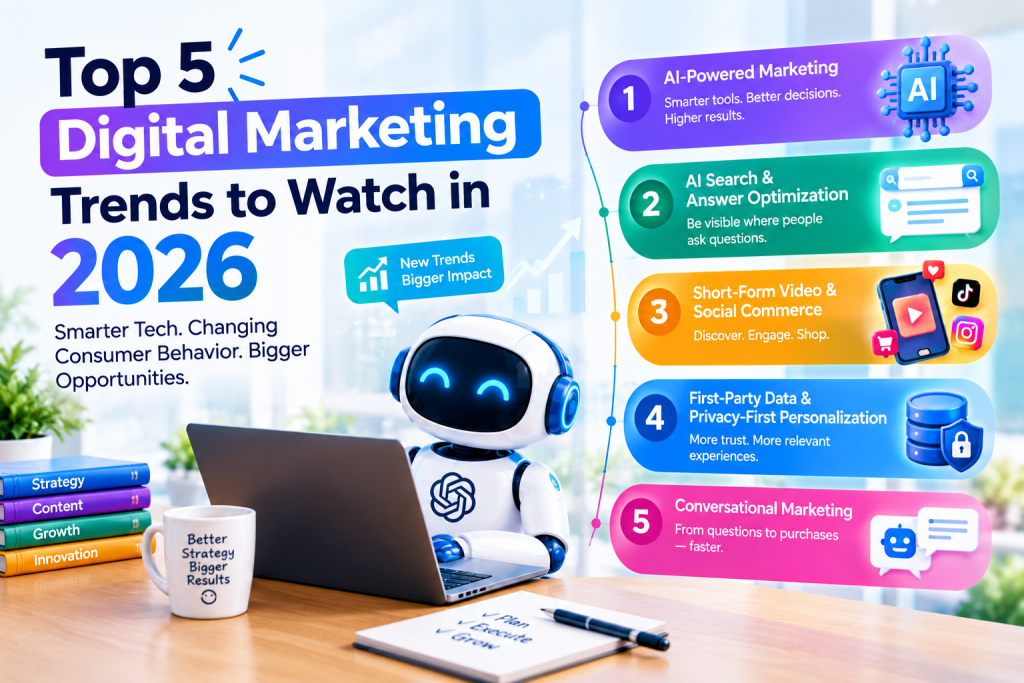
Here are the top 5 digital marketing trends to watch in 2026 and practical ways businesses can use them.
1. AI Is Becoming the New Marketing Co-Pilot
Artificial intelligence is no longer just an experimental marketing tool.
In 2026, AI is becoming part of everyday marketing workflows—from content creation and customer segmentation to campaign optimization, analytics, personalization, and automation.
Experian’s 2026 research reports that 94% of marketers are investing broadly in AI to drive efficiency and impact. Gartner also highlights generative AI and AI agents as major forces reshaping marketing operations and customer interactions.
How marketers are using AI
AI can help businesses:
- Generate content ideas
- Create campaign variations
- Analyze customer behavior
- Personalize marketing messages
- Automate repetitive tasks
- Summarize marketing reports
- Predict customer behavior
- Optimize advertising campaigns
- Create social media content
- Assist with customer service
The important shift in 2026 is that marketers are moving beyond simply asking AI to “write a blog post.”
AI is increasingly becoming a marketing co-pilot that helps teams research, plan, execute, analyze, and optimize campaigns.
What businesses should do
Don’t try to automate everything.
Start by identifying repetitive tasks that consume your team’s time. Use AI to accelerate those tasks while keeping humans responsible for strategy, brand voice, accuracy, creativity, and important decisions.
The winning combination in 2026: AI efficiency + human creativity.
One of the biggest changes in digital marketing is happening in search.
2. SEO Is Evolving Into AI Search and Answer Optimization
People are increasingly using AI-powered search and conversational interfaces to research products, ask questions, compare brands, and discover information.
HubSpot’s 2026 research reports that half of consumers use AI-powered search, while many marketers are adapting their SEO strategies to AI-generated answers and answer engines.
This means businesses can no longer think only about:
“How do I rank #1 on Google?”
They also need to ask:
“How can I make my brand useful, trustworthy, and visible when AI systems answer customer questions?”
This emerging approach is often described through terms such as Generative Engine Optimization (GEO) and Answer Engine Optimization (AEO).
What changes for marketers?
Instead of creating content solely around individual keywords, businesses should focus on:
- Answering real customer questions
- Demonstrating first-hand expertise
- Building topical authority
- Providing accurate and structured information
- Creating genuinely useful content
- Strengthening brand credibility
- Maintaining consistent information across important online sources
For example, a travel company shouldn’t only target:
“best places to visit in India.”
It could also answer questions such as:
- Where should a family travel in India in December?
- What are the best destinations for a 5-day trip?
- How much does a Goa trip cost?
- What should first-time visitors know before traveling to Rajasthan?
The goal is to become a useful source of information wherever customers are searching—including AI-powered experiences.
2026 takeaway
SEO isn’t disappearing. Search is expanding.
Smart marketers will optimize for traditional search results and AI-generated answers.
3. Short-Form Video, Creators and Social Commerce Will Drive Discovery
Social media is no longer just a place where people follow friends or consume entertainment.
It is increasingly becoming a discovery, search, shopping, and customer-service channel.
HubSpot’s 2026 social media research highlights the continued importance of short-form video, social search, creator marketing, social commerce, and community building.
In India, Meta says shopping behavior is increasingly moving toward a scroll-led journey powered by AI recommendations, Reels, creators, and conversational messaging.
Why short-form video matters
Short-form videos can communicate:
- Product benefits
- Tutorials
- Customer stories
- Behind-the-scenes content
- Industry insights
- Demonstrations
- Reviews
- Before-and-after experiences
And unlike traditional advertising, good social content can introduce a product while the customer is actively discovering something new.
Creator marketing is changing too
Brands don’t necessarily need celebrities with millions of followers.
Micro- and niche creators can provide something increasingly valuable:
trust and relevance.
A creator who has a highly engaged audience in a specific niche may be more useful to a brand than a celebrity with a massive but less targeted audience.
Social commerce is also growing
The journey is becoming increasingly connected:
Discover → Watch → Engage → Ask → Buy
Instead of sending every customer from social media to another website, brands can increasingly create experiences where discovery, conversation, and purchasing happen closer together.
What businesses should do
Create a video-first content strategy.
Experiment with:
- Reels
- YouTube Shorts
- Educational videos
- Product demonstrations
- Creator collaborations
- Customer-generated content
- Live shopping
- Social-first product launches
And remember:
Don’t create videos simply because video is trending. Create videos that solve customer problems.
4. First-Party Data and Privacy-First Personalization Will Become More Important
Personalization is powerful—but businesses need reliable data to personalize experiences effectively.
This is why first-party data is becoming increasingly important.
First-party data is information a business collects directly from its customers through channels such as:
- Website interactions
- Purchases
- Email subscriptions
- Customer accounts
- Surveys
- Loyalty programs
- Customer service interactions
- App activity
Experian’s 2026 research found that 70% of B2B marketers plan to increase their use of first-party data, highlighting the growing importance of data owned and collected directly by businesses.
Why first-party data matters
Businesses want to provide personalized experiences, but customers also expect greater transparency and control over their information.
This creates a new marketing challenge:
How do you personalize without compromising trust?
The answer is increasingly a combination of:
Consent + transparency + useful experiences + responsible data management.
Example
Imagine an online clothing store.
Instead of sending every customer the same promotional email, it could use customer-approved information to provide more relevant recommendations based on:
- Previous purchases
- Product preferences
- Browsing behavior
- Size preferences
- Communication preferences
That’s more useful than sending generic discounts to everyone.
2026 takeaway
The future of personalization isn’t simply more data.
It’s better, cleaner, permission-based data used intelligently.
5. Conversational Marketing and AI-Powered Customer Journeys Will Grow
The traditional marketing funnel looks something like this:
Awareness → Consideration → Purchase → Retention
But modern customer journeys are becoming much less linear.
A customer might discover a brand through Instagram, ask an AI tool for recommendations, watch a YouTube review, message the business on WhatsApp, compare prices, and finally purchase through an e-commerce platform.
This means businesses need to think beyond individual channels.
They need to create a connected customer journey.
AI and conversational marketing are helping make this possible.
Conversational marketing can include:
- AI chatbots
- WhatsApp conversations
- Website chat
- AI shopping assistants
- Personalized recommendations
- Automated lead qualification
- Customer-support automation
- Follow-up messages
Instead of forcing customers to navigate complicated websites or forms, businesses can allow customers to ask questions naturally.
For example:
“Which laptop is best for video editing under ₹80,000?”
A conversational system could help narrow down options based on the customer’s requirements.
The same concept can work for travel, education, healthcare services, finance, e-commerce, SaaS, and many other industries—subject to appropriate human oversight and regulatory requirements.
The opportunity
Businesses can use conversational marketing to shorten the distance between:
Question → Recommendation → Decision → Purchase
But the experience must feel helpful rather than intrusive.
Which Digital Marketing Trend Should You Prioritize?
Not every business needs to invest equally in all five trends.
Your priorities should depend on your business model.
| Business Goal | Trend to Prioritize |
|---|---|
| Increase productivity | AI-powered marketing |
| Improve organic visibility | AI search + SEO/AEO |
| Build brand awareness | Short-form video + creators |
| Improve personalization | First-party data |
| Generate and qualify leads | Conversational marketing |
| Increase online sales | Social commerce + AI personalization |
| Build long-term customer relationships | First-party data + community |
The smartest strategy isn’t to chase every trend.
It’s to identify the trends that directly connect with your customers and business objectives.
How to Prepare Your Digital Marketing Strategy for 2026
You don’t need to completely rebuild your marketing strategy.
Instead, take a practical approach.
Step 1: Audit your current channels
Identify which channels currently generate traffic, leads, sales, and customer engagement.
Step 2: Identify repetitive work
Look for tasks that could be accelerated or automated with AI.
Step 3: Improve your content
Create content that answers real customer questions instead of producing content simply to target keywords.
Step 4: Build your first-party data strategy
Make sure you’re collecting useful customer information responsibly and with appropriate consent.
Step 5: Invest in video
Experiment with short-form educational, entertaining, and product-focused content.
Step 6: Connect your customer journey
Make it easy for customers to move from discovery to conversation to purchase.
Step 7: Measure business outcomes
Don’t measure success only through:
- Likes
- Followers
- Impressions
- Website traffic
Also track:
- Leads
- Conversion rate
- Customer acquisition cost
- Revenue
- Customer lifetime value
- Repeat purchases
- Qualified engagement
Final Thoughts
Digital marketing in 2026 is becoming more intelligent, conversational, personalized, and fragmented.
AI is changing how marketers work.
AI-powered search is changing how customers discover brands.
Short-form video and creators are changing how people discover products.
First-party data is changing how businesses personalize experiences.
And conversational marketing is changing how customers move from questions to purchases.
But one thing hasn’t changed:
Successful marketing starts with understanding the customer.
Technology can help businesses move faster, analyze more data, and automate more processes. But brands that combine technology with genuine expertise, creativity, trust, and customer understanding will have the strongest advantage.
So don’t try to follow every trend.
Choose the trends that matter to your audience, test them, measure the results, and scale what works.
That is the real digital marketing strategy for 2026.