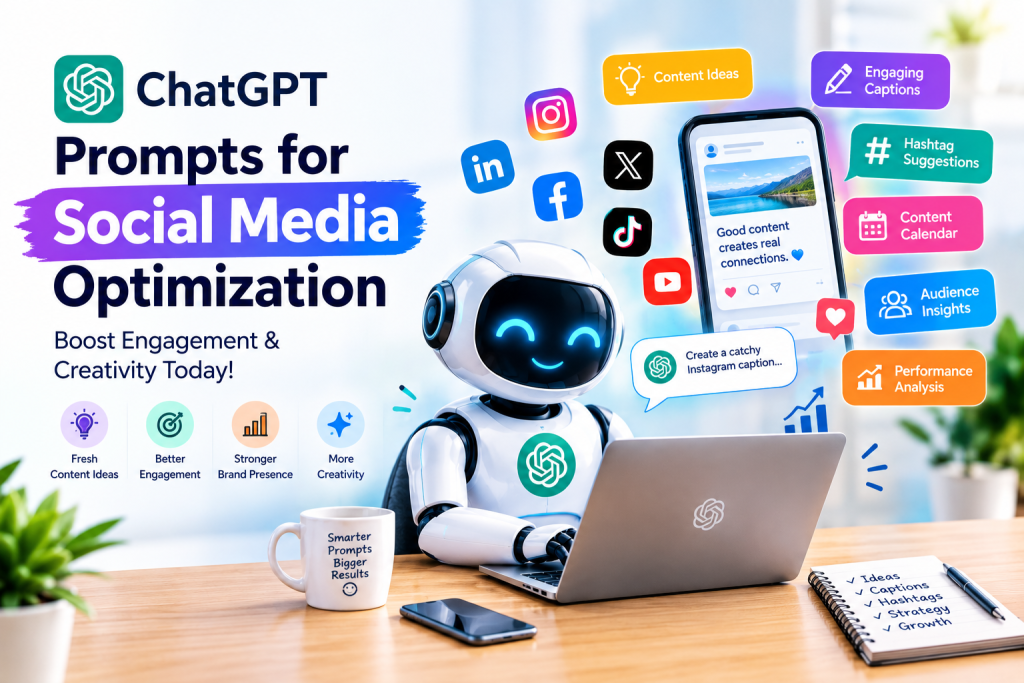
Creating engaging social media content consistently can be challenging. You need fresh ideas, compelling captions, relevant hashtags, strong visuals, and a content strategy that keeps your audience interested.
This is where ChatGPT prompts for Social Media Optimization (SMO) can become a powerful part of your marketing workflow.
Instead of staring at a blank screen wondering what to post, you can use well-designed prompts to generate ideas, improve captions, understand your audience, create content calendars, and optimize your social media strategy.
The key is not simply asking ChatGPT, “Give me a social media post.”
The better approach is to provide context, audience, platform, objective, tone, and desired outcome.
In this guide, you’ll find practical ChatGPT prompts that can help you improve your social media marketing from content creation to analytics.
What Is Social Media Optimization?
Social Media Optimization, commonly known as SMO, is the process of improving your social media presence to increase visibility, engagement, traffic, brand awareness, and conversions.
SMO can involve:
- Creating valuable content
- Optimizing social media profiles
- Improving captions
- Using relevant hashtags and keywords
- Increasing audience engagement
- Understanding social media trends
- Creating platform-specific content
- Analyzing performance
- Encouraging shares and conversations
ChatGPT can assist with many of these activities, making it easier to develop and execute a consistent social media strategy.
How to Write Better ChatGPT Prompts for Social Media
Before jumping into the prompts, remember this simple formula:
Role + Context + Audience + Platform + Goal + Tone + Output Format
For example, instead of:
“Write an Instagram caption.”
Try:
“Act as an experienced social media strategist. Write an engaging Instagram caption for a digital marketing agency targeting small business owners. The goal is to encourage saves and comments. Use a friendly, authoritative tone, start with a strong hook, keep it under 150 words, and finish with a question.”
The second prompt gives ChatGPT much more useful information.
15 ChatGPT Prompts for Social Media Optimization
1. Generate Social Media Content Ideas
Use this prompt when you need fresh ideas.
Prompt:
Act as a social media strategist for [business/industry]. Generate 30 creative social media content ideas for [target audience]. Divide them into educational, entertaining, inspirational, promotional, and engagement-focused categories. Make the ideas practical, original, and suitable for [Instagram/LinkedIn/Facebook/X].
2. Create a 30-Day Social Media Calendar
Create a 30-day social media content calendar for my [business type]. My target audience is [audience]. My main goals are [brand awareness/leads/sales/engagement]. Include the date, platform, content topic, post format, hook, caption idea, CTA, and suggested hashtags.
3. Write an Engaging Instagram Caption
Write 5 Instagram captions for [topic/product/service]. Target audience: [audience]. Use a conversational tone and create a strong opening hook. Include a clear CTA that encourages comments, saves, or shares. Avoid generic marketing language.
4. Create LinkedIn Posts
Act as a LinkedIn content strategist. Write 5 LinkedIn posts about [topic] for [target audience]. Make them insightful, professional, and conversational. Start each post with a compelling hook and end with a question that encourages meaningful discussion.
5. Generate Facebook Content Ideas
Generate 20 Facebook post ideas for [business]. The target audience is [audience]. Focus on increasing comments, shares, and community engagement. Include a mixture of educational, storytelling, question-based, entertaining, and promotional posts.
6. Create Short-Form Video Ideas
Generate 20 short-form video ideas for Instagram Reels, YouTube Shorts, and TikTok about [topic]. For each idea, provide a hook, 30-second script outline, visual concept, CTA, and suggested caption.
7. Generate Viral-Style Hooks
Give me 30 attention-grabbing hooks for social media content about [topic]. Make them curiosity-driven without using misleading clickbait. Include different styles such as questions, surprising statements, mistakes, statistics, challenges, and “how-to” hooks.
8. Improve an Existing Caption
Rewrite the following social media caption to make it more engaging, clear, persuasive, and natural. Preserve the original meaning but improve the hook, readability, emotional appeal, and CTA. Give me 3 versions: professional, conversational, and bold.
9. Generate Social Media CTAs
Generate 30 creative calls-to-action for social media posts promoting [product/service/topic]. Divide them into CTAs for comments, shares, saves, clicks, direct messages, and purchases. Avoid repetitive phrases.
10. Create Hashtag Ideas
Generate a relevant hashtag strategy for my [business/product/content]. My target audience is [audience], and I am targeting [location/niche]. Give me a balanced mix of broad, medium-competition, niche, branded, and location-based hashtags. Explain how each group can be used.
11. Find Content Pillars
Act as a social media marketing strategist. Based on my business, [describe business], identify 5–7 content pillars that I can use to build a consistent social media strategy. For each pillar, provide 10 content ideas and explain its purpose in the customer journey.
12. Create Audience Personas
Create 3 detailed social media audience personas for my business, [business description]. Include their demographics, interests, pain points, goals, objections, preferred content formats, social media behavior, and topics they are likely to engage with.
13. Generate Poll Questions
Create 25 interesting social media poll questions for [target audience] related to [industry/topic]. Make them easy to answer and designed to encourage participation while also providing useful audience insights.
14. Create Questions That Encourage Comments
Generate 20 conversation-starting questions for my social media audience about [topic]. Avoid questions that can be answered with a simple “yes” or “no.” Make them relatable, opinion-based, and likely to encourage thoughtful comments.
15. Turn a Blog Post Into Social Media Content
Convert the following blog post into a social media content package. Create 5 LinkedIn posts, 5 Instagram captions, 5 Facebook posts, 10 short-form video ideas, and 10 social media hooks. Maintain the core message while adapting the style to each platform.
Bonus: Prompt for Creating Better Content With AI
One of the biggest mistakes marketers make is asking AI to create content without providing enough information.
Use this framework:
Instead of:
“Write a post about digital marketing.”
Try:
“Act as a digital marketing expert and social media strategist. Create a LinkedIn post about 5 common digital marketing mistakes made by small businesses. The audience is Indian small business owners with limited marketing budgets. Start with a strong curiosity-driven hook, provide five practical lessons with examples, use a friendly but authoritative tone, avoid unnecessary jargon, and end with a question that encourages comments. Keep the post under 1,200 characters.”
The second prompt gives the AI a clear job, audience, objective, platform, tone, structure, and constraints.
That usually produces a much more useful starting point.
How to Get Better Results From ChatGPT
The quality of your output depends heavily on the quality of your input.
When creating prompts, include these seven elements:
| Element | What to Include |
|---|---|
| Role | Tell ChatGPT who it should act as |
| Context | Explain your business or topic |
| Audience | Describe who you’re targeting |
| Platform | Instagram, LinkedIn, Facebook, etc. |
| Goal | Engagement, leads, sales, awareness |
| Tone | Professional, friendly, humorous, bold |
| Format | Caption, carousel, Reel, calendar, etc. |
You can think of it as:
Better Context → Better Prompt → Better Output → Better Content
Don’t Let AI Make Your Social Media Generic
AI can help you create content faster, but speed shouldn’t come at the expense of originality.
Avoid publishing AI-generated posts without reviewing them.
Before posting, ask:
- Does this sound like our brand?
- Is the information accurate?
- Does it provide something genuinely useful?
- Would our audience care about this?
- Is there an original insight or perspective?
- Is the CTA appropriate?
- Does the content fit the platform?
- Have we removed unnecessary AI-style language?
The goal isn’t to create more content.
The goal is to create better content that people actually want to consume, save, share, and discuss.
Final Thoughts
ChatGPT can become a valuable assistant for social media marketers.
It can help you overcome creative blocks, generate content ideas, develop campaigns, improve captions, repurpose existing content, analyze performance, and build a more consistent social media strategy.
But the most effective marketers won’t simply copy and paste AI-generated content.
They will use AI for ideas, research, structure, experimentation, and efficiency, while bringing their own expertise, personality, creativity, and understanding of their audience.
Start with one prompt from this guide. Test the result. Improve the prompt with more context. Then turn the process into a repeatable workflow.
The better you learn to communicate with AI, the more useful AI becomes as part of your social media strategy.