
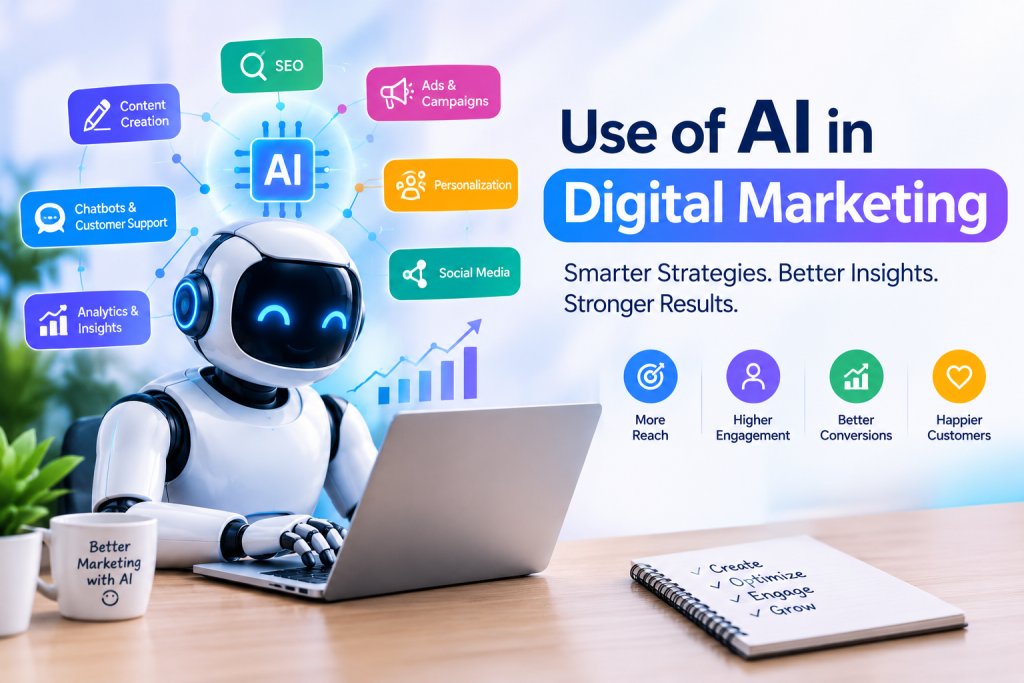
Artificial intelligence (AI) is no longer a futuristic concept reserved for technology companies. It has quickly become one of the most powerful tools available to digital marketers.
From creating content and analyzing customer behavior to optimizing advertising campaigns and personalizing customer experiences, AI is changing how businesses attract, engage, and retain customers.
But there is an important distinction: AI is not replacing digital marketers—it is changing what successful digital marketers are able to do.
Instead of spending hours performing repetitive tasks, marketers can use AI to analyze huge amounts of data, identify patterns, generate ideas, automate workflows, and make faster decisions.
In this article, we’ll explore the use of AI in digital marketing, its major applications, benefits, challenges, practical examples, and how businesses can use it effectively.
What Is AI in Digital Marketing?
AI in digital marketing refers to the use of artificial intelligence technologies—including machine learning, natural language processing, predictive analytics, computer vision, and generative AI—to improve marketing activities.
AI can process large amounts of information much faster than humans. It can identify customer behavior patterns, predict potential outcomes, generate content, automate communication, and help marketers make data-driven decisions.
For example, an e-commerce company can use AI to:
- Recommend products based on a customer’s browsing history
- Predict which customers are likely to make a purchase
- Generate product descriptions
- Create personalized email campaigns
- Analyze advertising performance
- Provide automated customer support through chatbots
The result is a marketing process that can be faster, more personalized, and more data-driven.
Why Is AI Becoming Important in Digital Marketing?
Traditional digital marketing often requires marketers to spend significant time collecting data, creating content, analyzing campaigns, managing customer interactions, and optimizing advertisements.
AI can assist with many of these activities.
The biggest advantages include:
1. Faster execution
AI can help marketers generate first drafts, analyze data, summarize reports, create campaign variations, and automate repetitive workflows.
2. Better personalization
Modern customers expect brands to understand their interests. AI can analyze customer behavior and help marketers deliver more relevant messages, offers, and recommendations.
3. Data-driven decision making
Instead of relying entirely on intuition, marketers can use AI-powered analytics and predictive models to identify patterns and opportunities.
4. Improved productivity
AI can handle repetitive tasks while marketers focus on strategy, creativity, brand positioning, and customer relationships.
5. Scalable marketing
A small marketing team can use AI to perform tasks that would previously require significantly more time and resources.

10 Major Uses of AI in Digital Marketing
1. AI-Powered Content Creation
One of the most visible applications of AI in digital marketing is content creation.
Generative AI tools can assist marketers with:
- Blog ideas
- Content outlines
- Social media posts
- Email drafts
- Product descriptions
- Ad copy
- Video scripts
- Headlines
- FAQs
- Content repurposing
For example, a marketer can take one long-form blog post and use AI to turn it into:
1 blog post → 5 social media posts → 1 email newsletter → 1 video script → several short-form content ideas
This can dramatically improve content production efficiency.
However, AI-generated content should not simply be published without review. Human expertise is essential for fact-checking, originality, brand voice, examples, opinions, and useful insights.
Best practice
Use AI as a content assistant, not as a complete replacement for human expertise.
2. AI and SEO
Search engine optimization is another area where AI can support marketers.
AI can help with:
- Keyword research
- Search intent analysis
- Content clustering
- Topic research
- Content briefs
- Competitor analysis
- Internal linking opportunities
- Content optimization
- SERP analysis
- Identifying content gaps
For example, instead of targeting individual keywords separately, marketers can use AI to identify related topics and build comprehensive content around a broader subject.
This supports a more user-focused approach to SEO.
Example
Suppose a website sells running shoes.
Instead of publishing one article targeting “best running shoes,” a marketer could create a broader content cluster covering:
- Best running shoes for beginners
- Running shoes for flat feet
- Running shoes for marathon training
- How to choose running shoes
- Running shoe size guide
- Running shoes vs walking shoes
AI can help identify relationships between these topics and organize them into a content strategy.
Personalization has become one of the most important applications of AI.
AI can analyze information such as:
- Browsing behavior
- Purchase history
- Demographics
- Engagement patterns
- Previous interactions
- Product preferences
Businesses can then use these insights to deliver more relevant experiences.
For example, an online store might show different product recommendations to two visitors based on their previous activity.
Similarly, an email platform can help marketers segment audiences and deliver different messages based on customer behavior.
The goal is simple:
The right message → to the right person → at the right time.
4. AI Chatbots and Customer Support
AI-powered chatbots can provide customers with instant assistance at any time of the day.
They can help with:
- Frequently asked questions
- Product information
- Order updates
- Appointment scheduling
- Basic troubleshooting
- Lead qualification
- Product recommendations
This can reduce response times and allow customer support teams to focus on more complex issues.
However, businesses should provide an easy way for customers to reach a human when the situation requires empathy, judgment, or specialized assistance.
5. AI in Social Media Marketing
Managing multiple social media channels can be time-consuming.
AI can assist with:
- Content ideas
- Caption generation
- Post scheduling
- Audience analysis
- Sentiment analysis
- Trend identification
- Comment analysis
- Social listening
- Performance reporting
AI can also help marketers understand which types of content generate the strongest engagement.
For example, after analyzing months of social media data, AI may identify that educational videos consistently outperform promotional posts.
A marketer can then adjust the content strategy accordingly.
6. AI-Powered Advertising
Paid advertising is another area where AI can have a major impact.
Advertising platforms increasingly use machine learning to optimize campaign delivery and identify audiences that are more likely to take a desired action.
Marketers can also use AI to create and test:
- Ad headlines
- Descriptions
- Creative concepts
- Audience segments
- Landing-page variations
- Campaign ideas
AI can help marketers identify patterns in campaign performance and suggest areas for optimization.
However, marketers should still monitor campaigns closely. Automated optimization does not eliminate the need for strategic thinking.
7. Predictive Analytics
One of the most valuable applications of AI is predicting future customer behavior.
Predictive analytics can help businesses estimate:
- Which customers are likely to purchase
- Which customers may stop engaging
- Which products may be in demand
- Which leads are more valuable
- Which campaigns are likely to perform well
For example, a subscription business could use historical customer data to identify customers who are at higher risk of cancelling.
The marketing team could then create a targeted retention campaign.
Instead of simply reacting to customer behavior, the business can attempt to anticipate it.
8. Email Marketing Automation
AI can make email marketing more intelligent and personalized.
It can help marketers determine:
- Which customers should receive an email
- What type of content they may prefer
- Which subject lines could be tested
- When customers are most likely to engage
- Which products should be recommended
For example, an online retailer could send different emails to:
New customers: Welcome and onboarding content
Active customers: Product recommendations
Inactive customers: Re-engagement campaigns
High-value customers: Exclusive offers
This type of segmentation can make email communication more relevant and useful.
9. AI for Customer Journey Analysis
A customer rarely goes directly from seeing an advertisement to making a purchase.
The journey may look like:
Social media → Website → Blog → Email → Product page → Retargeting ad → Purchase
AI can analyze interactions across different stages of this journey and help marketers understand where customers are dropping off.
For example, if many users visit a product page but leave without purchasing, the company can investigate possible reasons such as:
- Poor product information
- Slow website performance
- Complicated checkout
- Lack of trust signals
- Unexpected pricing
- Weak calls to action
AI can help identify patterns, but marketers still need to investigate the underlying business problem.
10. AI for Marketing Analytics and Reporting
Marketing generates enormous amounts of data.
AI can help transform this data into useful insights.
Instead of manually reviewing multiple dashboards, marketers can use AI-assisted analytics to identify:
- Campaign trends
- Traffic changes
- Conversion patterns
- Customer segments
- Underperforming channels
- High-performing campaigns
- Potential anomalies
The real value is not simply producing more reports.
It is answering the question:
“What should we do next?”
That is where AI-assisted analysis becomes particularly valuable.
Benefits of Using AI in Digital Marketing
When implemented correctly, AI can provide several benefits.
Increased productivity
AI can reduce the time required for repetitive marketing tasks.
Better customer experiences
Personalization can make interactions more relevant to individual customers.
Faster decision-making
AI can process large amounts of information quickly and identify patterns that may be difficult to spot manually.
Cost efficiency
Automation can reduce the amount of manual work involved in certain marketing processes.
Improved scalability
Businesses can produce and manage more marketing activities without increasing their teams at the same rate.
More opportunities for experimentation
AI makes it easier to generate multiple ideas and variations that marketers can test.